sunt lacrimae rerum.: On Sixsmith/Frobisher (part 3)

mintparades:

Seems like the Frobisher/Eva anon has a hard time letting things go. And you know what, I can’t either. Because they’re harassing the Cloud Atlas fandom and they need to stop.

Part one of my responses to them include examples of Sixsmith/Frobisher hints through quotes directly from the book.

Um…wow.  A sizable fandom for this book/film must have developed entirely while I wasn’t looking, especially for there to be shipping wars.  Don’t get the impression that I’m mocking you, though; I love the analysis in these posts, and some of those anon comments are so inane that I feel I have to take a crack at them myself.  As a disclaimer, I don’t have the book with me at the moment, so I won’t be able to make any direct quotes.

I have no idea how anyone could consider Frobisher/Sixsmith as a form of political correctness.  I talked about my first impressions of the pairing a while back here (film) and here (book), and I stand by what I said about my appreciation for Frobisher – book!Frobisher especially – possessing a rather more fluid sexuality than what one generally sees in fiction with explicitly queer characters.  His is a reckless, sensual bisexuality, but I believe that there are ample small touches in the text that, though he may not be as deeply committed to Sixsmith as one might expect of a romantic hero (which is fine considering he’s not one), he still cares for him perhaps even more than he consciously acknowledges.

A good bit of that has to do with writing style – Mitchell’s attention to varying the style of his writing by historical period is extensive, with The Pacific Journal and Letters from Zedelghem in particular conforming to most of the conventions of their respective settings.  The latter conforms to the temporal reality that, from around the 1880s to well into the sexual revolution of the 1960s-70s, homosexuality was a publically acknowledged fact, treated as a (potentially curable) mental illness, criminalized in Great Britain among other places, and thus a taboo subject for explicit representation in writing.  Thus, Frobisher’s letters are extensively coded when it comes to all sexual topics but homosexual ones especially – for minor (and therefore less controversial) examples, compare his flirtations with a Belgian girl in town to his sexual encounters with two random men.  Initially this appears as a safety precaution for himself, until one recalls that Frobisher hasn’t got much of a reputation left to lose at this point, especially by the time of his suicide letter.  If he’s saving anyone by coding his feelings, it’s Sixsmith, who has a bright career ahead of him that could be irrevocably destroyed were letters explicitly mentioning a sexual relationship with another man ever to become public.  Even Luisa’s initial reaction to reading the letters – muted as it is by four decades, a vastly different social climate, and the somber freshness of Sixsmith’s murder – conveys a certain level of implicit judgment of the man over his relationship with Frobisher.

As for homosexuality in Cloud Atlas as political correctness, I would ask the anon to look beyond Letters from Zedelghem, as both The Pacific Journal and Sloosha’s Crossin’ contain decidedly non-PC depictions of male-on-male rape, with the former including Ewing’s moralizing on the subject in a manner typical for the mid-19th century.  There’s also Luisa’s aforementioned reaction to the letters and at least one instance of Cavendish dropping a reference to lesbians in The Ghastly Ordeal, but as generally misanthropic as Cavendish is I think that’s simply a direct statement on the continued pervasiveness of casual homophobia even in the early 21st century.  Frobisher/Sixsmith, embedded as it is à la Wilde or Woolf or any other Victorian/modernist writer working with queer subtext, feels like a much-needed contrast to all that.  The fact that Frobisher is a scoundrel and not all that into monogamy only makes his character more compelling, and because of it – to say nothing of his views on art and life – his suicide is less a moment of total pathos compared with those of two other (arguably) queer characters in literature of the period, Septimus Smith of Mrs. Dalloway and Quentin Compson of The Sound and the Fury.

But…Sixsmith or Eva?  I think that’s pretty clear.
sunt lacrimae rerum.: On Sixsmith/Frobisher (part 3)

You groan and shake your head, Sixsmith, I know, but you smile too, which is why I love you.

Letters From Zedelghem, Cloud Atlas (via andthedeadseaswillcarrymehome)

Reblogged to point out that this one of the surprisingly few Frobisher/Sixsmith quotes that appears in both the book and the movie.  I’m not just talking about a film version cutting material out as per usual; many of their often-repeated lines or even minor plot threads appear only in the movie.  The really big “other world” quote is even directly contradicted by Frobisher waxing philosophic on reincarnation in the book (like every other narrator in Cloud Atlas then).

Usually it’s an easy choice between a book and a film adaptation for me, but in this case it’s actually a tough call.  I’ve even written at length on both versions and still can’t make a decision.  Eh…

“The sole love of my short, bright life”: revisiting Frobisher and Sixsmith

Frobisher and Sixsmith

This is technically a part of my slash series, a continuation of the movie verse Frobisher/Sixsmith post I made a little while ago.  Now that I’ve finished Cloud Atlas the novel and have what the cool kids these days are apparently calling “feels,” I believed that another post on these two was warranted.  Spoilers and homoeroticism, as always, are below the cut.

I cannot help but remark on the differences between these two versions of this same “many-headed” narrative: each story of Cloud Atlas was altered in various substantial ways in the process of adaptation.  For the most part the changes were necessary to accommodate the difference in medium (for example, duplicating exactly the novel’s structure in the film would be highly unfeasible, and the film’s structure could never be coherently rendered in novel form).  In some cases, I preferred the film’s methods of tying together the six narratives; though the novel is able to spend more time on replicating small details across various stories (like Ewingsville and the restored Prophetess in Half-Lives: The First Luisa Rey Mystery or the cloning operation run by “shady Koreans” in The Ghastly Ordeal of Timothy Cavendish), I felt like the film’s decision to re-use the same actors in multiple roles and to emphasize more thematically significant details (like the birthmark) worked more effectively at creating the sense of a unified whole.  As rare as it is for me (or many people, at least publicly) to say, I think I slightly prefer the movie version.

However, my goal is not an exhaustive comparison of these two versions of Cloud Atlas or even one for the story that captures most of my attention, Letters from Zedelghem.  I firmly trust in the Internet’s penchant for amateur review and criticism to have already accomplished that somewhere.  Instead, I want to take a second look at my comments on Frobisher/Sixsmith I made earlier, analyzing them to see how well they hold up in light of their novel characterizations.  The two characters remain essentially unchanged save that Frobisher is more obviously bisexual – he flirts with multiple women, has two brief encounters with random men, and pursues an ultimately unsuccessful and humiliating relationship with Ayrs’s daughter Eva.  These, coupled with his affair with Jocasta that made it into the movie version, only reinforces my opinion of Frobisher as a sensualist concerned more with the sensory pleasures of sex (or idealized courtship, in Eva’s case) than in the feelings of those with whom he shares these experiences.  Of course, he certainly values Sixsmith, though he rarely refers to their (romantic) relationship  – the title of this post contains perhaps the most direct reference – and he is perfectly frank with his lover in sharing stories of all his sexual exploits with others while in Belgium.  Though the original version of Letters from Zedelghem lacks the conventional markers of a sentimental love story that the films adds, I felt that the undercurrents of feeling present in Frobisher’s letters were equally powerful (if lacking in the eye candy factor of a naked Ben Whishaw and James D’Arcy).

Where, though, does this leave Sixsmith? He is the only character in the entire novel to physically appear in more than one story, and yet he is denied almost any voice of his own – his letters are only alluded to in Zedelghem, and in Half-Lives he appears only briefly as the harried murder victim whose report jettisons the plot.  If Frobisher is the reckless, promiscuous artist questioning heteronormative attitudes toward romantic and sexual relationships (among various other philosophical conundrums), Sixsmith is the ideal hero of a love story: loving and understanding to a fault, concerned with the well-being of people both known and unknown to him, loyal unto death, and even willing to undertake a personal rescue mission for his lover.  As admirable as his character is, though, I believe Mitchell was right to deny him a voice for all but the very beginning of Half-Lives.  In a novel with recurring themes of cannibalism (literal and figurative) and social darwinism as well as people like the Moriori and the Valleysmen and characters like Adam Ewing and Sonmi~451 who attempt to undermine these forces either for themselves or, more commonly, for those who will follow them, Sixsmith’s passivity no longer appears as worthy of admiration.  He is Frobisher’s emotional and sexual foil (even by being completely gay, though Frobisher keeps insisting he should “try” women) and his professional integrity sets into motion the events of Half-Lives and allows for Luisa Rey to demonstrate her own heroism, but he ever remains a supporting character nonetheless.  I do though feel that his contributions to those questions I raised regarding Frobisher/Sixsmith in the last post (i.e. sexual fidelity vs. emotional fidelity, etc.) are still relevant, especially as his approach to loving Frobisher is so typical of the “nice guy” romantic character archetype but so ineffective at preserving either his lover or their romance.

The reincarnation theme also deserves one final mention.  Frobisher in the film suggests the possibility of an afterlife as opposed to the reincarnation idea posited by many other characters and the story in its entirety.  I remarked that this discrepancy might be accounted for by sexuality; reincarnation is a cyclical cycle akin to biological reproduction, the “circle of life” and such, a process from which Frobisher/Sixsmith is obviously excluded.  The novel’s Frobisher, by contrast, does not draw this conclusion but instead ruminates on reincarnation like all the other protagonists.  His proposal differs in that he believes that his next life will be same as his first, even including his violent end.  Such, though, is Robert Frobisher, as he seems content to dwell on the possibility of living through past pleasures instead of the potential represented by a completely different life.  Robert Frobisher and Rufus Sixsmith will be eternally meeting and loving one another, becoming separated and then meeting all over all.  It’s so, so…

The feels, the feels!

Now I’ll be queering Kurtz and Marlow from Heart of Darkness on here next, crap.

I just saw your Cloud Atlas post and I think you have a very interesting point of view. I never took Frobisher’s bisexuality as being .. “unable” to have a monogamous relationship. I thought it was him in general wanting to break (free). Like, for instance, he wants to be a composer and he wants to be appreciated by his father, but when he leaves Cambridge he doesn’t seem to care about what his father is going to think of him. Though Ayrs treats him like a tool (to be continued, sorry <.<)

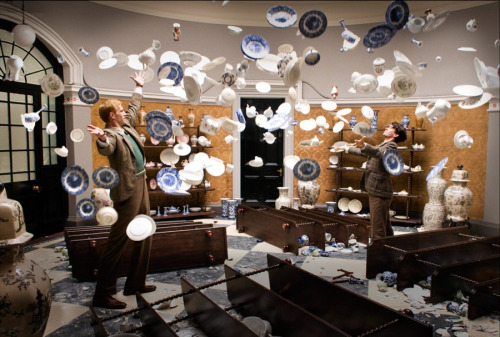
No, it’s perfectly fine, and I appreciate the opinion.  I hadn’t given much thought to how Frobisher’s backstory might influence his sexuality, so thanks for reminding me.  I said in my post that a few years ago I would have seen Frobisher as fulfilling the depraved bisexual stereotype, but now I agree with you that his character is all about breaking conventions, and in doing so he breaks down the idea that non-monogamous relationships (or indeed any non-normative relationships – the movie drives that point home by pairing the scene in the china shop with one of another “forbidden” sexual relationship, Hae Joo and Somni) are depraved in the first place.  He clearly has very different ideas about emotional and sexual intimacy than Sixsmith, who plays very much the pining faithful lover after Frobisher’s suicide (and as such comes across as more palatable from the perspective of a simple romantic narrative – would Sixsmith’s story have been as poignant if he’d had another lover in 1973?).  Frobisher, however, plays the romantic hero while maintaining a sexual fluidity that defies that convention (and is quite honest about it, in fact, considering he writes about his affair with Jocasta and his “transcendent” experience with Ayrs to Sixsmith).

A continuation of the slash series, one I’ve had in my head since November

Frobisher and Sixsmith

Robert Frobisher and Rufus Sixsmith, Cloud Atlas

It may not be prudent to engage in posting another one of my shamelessly self-indulgent ramblings, but they amuse me even if no one else reads them.  Furthermore, I have a feeling that one my new rebloggers would appreciate a brief discussion of this movie.  I say “movie” because I have not had the opportunity to read David Mitchell’s novel, though via the magic of the Internet I have become aware of many of the principal differences.  I’ll try not to make too many more references to the novel, though, as I dislike talking about a work based entirely on hearsay.  I have little to say about the overarching narrative (or quasi-narrative – other than some obvious thematic connections, I’d sooner describe Cloud Atlas as an experimental collection of six short stories of vastly different genres that only theoretically make up a complete novel).  The film by necessity blends the stories more obviously, though it does so in such inconclusive ways that I’m not surprised it didn’t do very well at the box office.  Is reincarnation at work?  What is the significance of the “comet” birthmark?  Is the cross-race acting supposedly to be thematically important, or is it just racist?  I greatly enjoyed the film, but I feel I have little more of substance to add regarding the broader implications of the narrative that has not already been covered exhaustively at some point.  

Moreover, my personal interests dictate that I focus on the 1930s story, “Letters from Zedelghem,” with its gay Cambridge romance.  In many ways I draw comparisons between this narrative and that of Maurice (a book I’ve already written on, so pick through my fairly small archive to locate this shameless plug), although this novel and especially its screenplay adaptation were clearly written for a more tolerant 21st century audience when compared with Forster’s long-unpublished novel.  This story in the movie opens with Frobisher (Ben Whishaw) and Sixsmith (James D’Arcy) spooning naked in bed, and in the same scene we get a kiss from them and an ass shot from Whishaw – in a widely released film!  It’s the next Brokeback Mountain, yay for progress!  

In all seriousness, though, although the narratives occur within twenty years of one another in much the same oppressive social milieu, Frobisher’s letters to Sixsmith contain none of the moral anxiety that Maurice and Clive experience – and to which Clive eventually succumbs, falling into the security of heterosexual marriage and leaving Maurice for a while without anyone to share in his inversion (in an era where such a thing was considered a treatable mental illness, incidentally).  However, part of this distinction owes itself to Frobisher’s characterization, as the man comes across as a largely amoral sensualist – externally censured for his sexuality but not particularly bothered by it internally.  He’s also not all that sexually faithful to Sixsmith, as he has an affair with Vyvyan Ayrs’s wife (a bisexual man exists in fiction, what’s this?) and then mistakes Ayrs’s enthusiasm for his music for romantic affection before that backfires horribly, to say nothing of the implication that he is or has been a prostitute.  Knowing about Frobisher’s infidelities really makes one feel all the more for Sixsmith, who arrives just barely too late to stop Frobisher’s suicide and then apparently spends the last forty or so years of his life without any long-term companionship.  

That Frobisher remains a sympathetic character in spite of this (and all the more so in contrast with the relatively straightforward heterosexual romances of the other storylines) is a product partially of our cognizance of the damaging effects of homophobia even today, but for my part I am not inclined to judge Frobisher’s sensuality too harshly either.  A few years back when I had just come out and was just developing an interest in GLBT studies I would have decried his characterization as that of the stereotypically depraved bi/homosexual man, concerned only with his own lusts (sexual and otherwise) and unwilling or unable to remain in a committed monogamous relationship.  Now, though, I recognize that this bias toward monogamy is one of the unfortunate side effects of the fight for legal and social equality for GLBT individuals.  Namely, we feel pressured to conform to heterosexual relationship paradigms – particularly as marriage remains a legally privileged institution with assorted financial and other benefits in most places – in order to prove to the majority that we are not “morally depraved” or any of the other common judgments on relationship models that deviate from the heteronormative standard.  

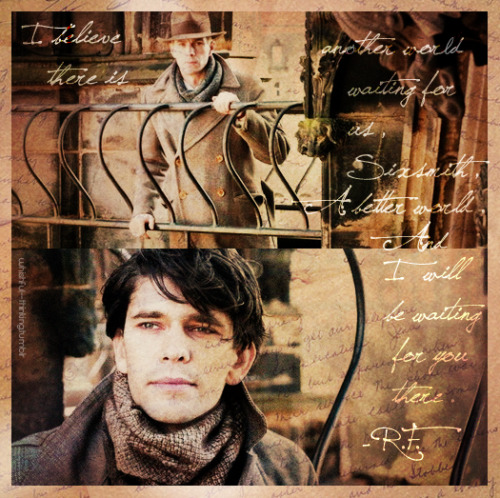
I won’t go any more into politics as I’m actually rather apolitical, but I will finish by saying that Frobisher raises refreshing questions concerning polyamory, sexual fidelity vs. emotional fidelity, and the penchant for non-monogamous relationships embedded in the very concepts of bi/pansexuality, questions that I find more thought-provoking than, say, trying to puzzle out who in Cloud Atlas is reincarnated into whom.  For that matter, Frobisher’s popular quote repeated in this picture above posits the possibility of an afterlife, which would exist entirely at odds with the reincarnation theme – I have trouble calling any of the other stories necessarily “better worlds.”  I suppose one could make the argument that the gay characters escape the metaphysically reproductive cycle of reincarnation that the other characters experience and find their resolution elsewhere, but I have gone on long enough as it is and so I must conclude, like the sections of the novel, in the middle of a thought, “like an unfinished love affair.”